

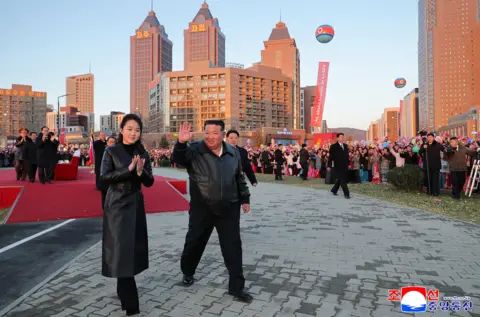
During warnings against Seoul and declarations to expand the nuclear weapons program, a central question hovered at the latest political assembly: might the leader's teenage child be named as the heir?
Although definitive announcement failed to materialise at the event, it has ignited a significant discussion about the young girl's prospects as the prospective ruler of the 25m-strong state, a regime solely governed by the Kim dynasty.
Growing Presence and Rumors
The young woman has become progressively prominent in state media with her father. Nonetheless, plenty about her is still unknown. Pyongyang has never publicly released her identity or confirmed her age.
Her existence was initially made known abroad in 2013. Over the years, she is commonly believed to be in her early teens, based on analyst assessments.
Evidence of Succession
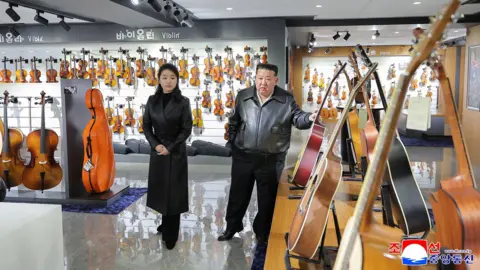
Analysts note several significant clues. Her regular appearances—often framed in the shot—and the use of honorific titles typically used for the ruler are seen as clear signals.
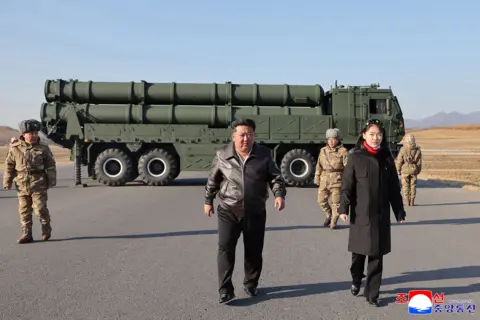
Moreover, her proximity with the army is considered an additional important factor. She has inspected soldiers and missiles alongside her father. On several occasions, senior generals have been observed stopping near her to confer during military displays.
"The state media is employing terminology set aside for the supreme leader. It reinforces her own cult of personality," states one respected expert.
Such strategic exposure is considered essential, as real power in North Korea lies with control over the armed forces. To be a credible future leader, she must appear as a competent commander.
Discussion Over Gender and Tradition
Nevertheless, a considerable skeptical perspective exists. Some experts believe that North Korea's inherently traditional system presents an insurmountable obstacle for a girl ruler.
Observers highlight that females at all level struggle for fair treatment. Women commanders in high offices are extremely rare. Everyday superstitions also demonstrate these biases.
"When it happens, they end the journey then go to the back of their car and spit thrice to dispel the misfortune," explains a ex- North Korean official.
Changing Social Landscape
Alternatively, other analysts suggest that the status of females in North Korea has transformed dramatically since the 1990s famine.
During that period, as the public system faltered, women increasingly became the main providers, turning to black market trade. This has reportedly led to a perceptible shift in societal dynamics.
A expert who has studied over 120 defectors argues that it is currently no longer unusual to see women in leadership jobs within the country.

"It is wrong to analyze North Korea with outside logic. We must imagine them as the royal court," says the expert. "What person would presume challenge a person of Kim blood who is taking the throne?"
Strategic Maneuvers
Current party developments are also being watched. The promotion of Kim Yo Jong, the leader's powerful sibling, to a senior ideological role is seen by some as a step to position a mentor for the young heir.
In the end, analysts are split. Some see the focus on Ju Ae as a calculated tactic to improve the leader's image and normalize another dynastic transfer of power. Others believe the signals of her preparation are too clear to overlook.
Irrespective, the speculation in and of itself may serve a purpose for the Pyongyang, ensuring international attention firmly trained on the isolated Kim rule.


